Platforms
What each network accepts, what it requires, and where they differ.
CuteDyno takes one post and publishes it several different ways. The API hides most of that, but not all of it — a platform that requires a video title, or refuses a video over a certain length, cannot be abstracted away.
This section covers what is specific to each network. Everything common to all of them is in Publishing.
At a glance
| Text | Images | Video | Notes | |
|---|---|---|---|---|
| Yes | 1 or many | Reels | Pages only | |
| No | Up to 10 | Reels | Professional accounts only | |
| TikTok | No | Yes | Yes | App audit affects visibility |
| Yes | 1 or many | Yes | Links become article shares | |
| YouTube | No | No | Yes | Pending Google verification |
YouTube is not connectable yet. It is going through Google's OAuth verification, so channels cannot be connected and posts cannot target one. The four networks above are live. YouTube behaviour is documented on its platform page so you can build against it in advance.
Instagram, TikTok, and YouTube reject text-only posts. If a post targets a mix and one of them is text-only, that account fails while the rest succeed — the post ends up partially_published. Check with POST /v1/posts/validate first.
Content type is inferred
You never declare a content type. CuteDyno reads the media array: a video makes it a video post, otherwise images make it an image post, otherwise it is text. Platform-specific shapes follow from there — a video to Instagram is published as a Reel, several images to Instagram become a carousel — without you choosing a format name.
Per-platform options
The platforms object carries settings that only exist on one network:
await cutedyno.posts.create({
  content: 'Same idea, three houses.',
  media: [{ type: 'video', url }],
  accountIds: [tiktokId, youtubeId, facebookId],
  platforms: {
    tiktok: { privacy_level: 'PUBLIC_TO_EVERYONE', disable_duet: true },
    youtube: { title: 'Same idea, three houses', privacyStatus: 'public' },
    facebook: { privacy: { value: 'PUBLIC' } },
  },
});
Options are applied only to accounts on that platform, so one payload can carry all of them. Each platform page below lists its own options in full.
What CuteDyno enforces, and what the platform does
CuteDyno checks a small number of things before spending an upload:
- File type and size at upload (100 MB, common image and video formats).
- TikTok video duration against the creator's own limit, which TikTok reports per account.
- TikTok photo titles, trimmed to 90 characters.
- Instagram carousels, capped at 10 images.
- YouTube posts, which need a title.
Everything else — caption lengths, aspect ratios, codec support, community guidelines — is decided by the platform when it receives the post. Those arrive as a per-account failure in results[].error with the platform's own wording, which is usually more accurate than anything we could predict in advance.
Text per platform
One caption rarely fits five networks. LinkedIn readers expect a paragraph; TikTok expects a line. Where a platform needs its own text, its platforms entry accepts it — platforms.youtube.title, platforms.tiktok.title, platforms.linkedin.title — and the shared content fills in everywhere else.
Analytics
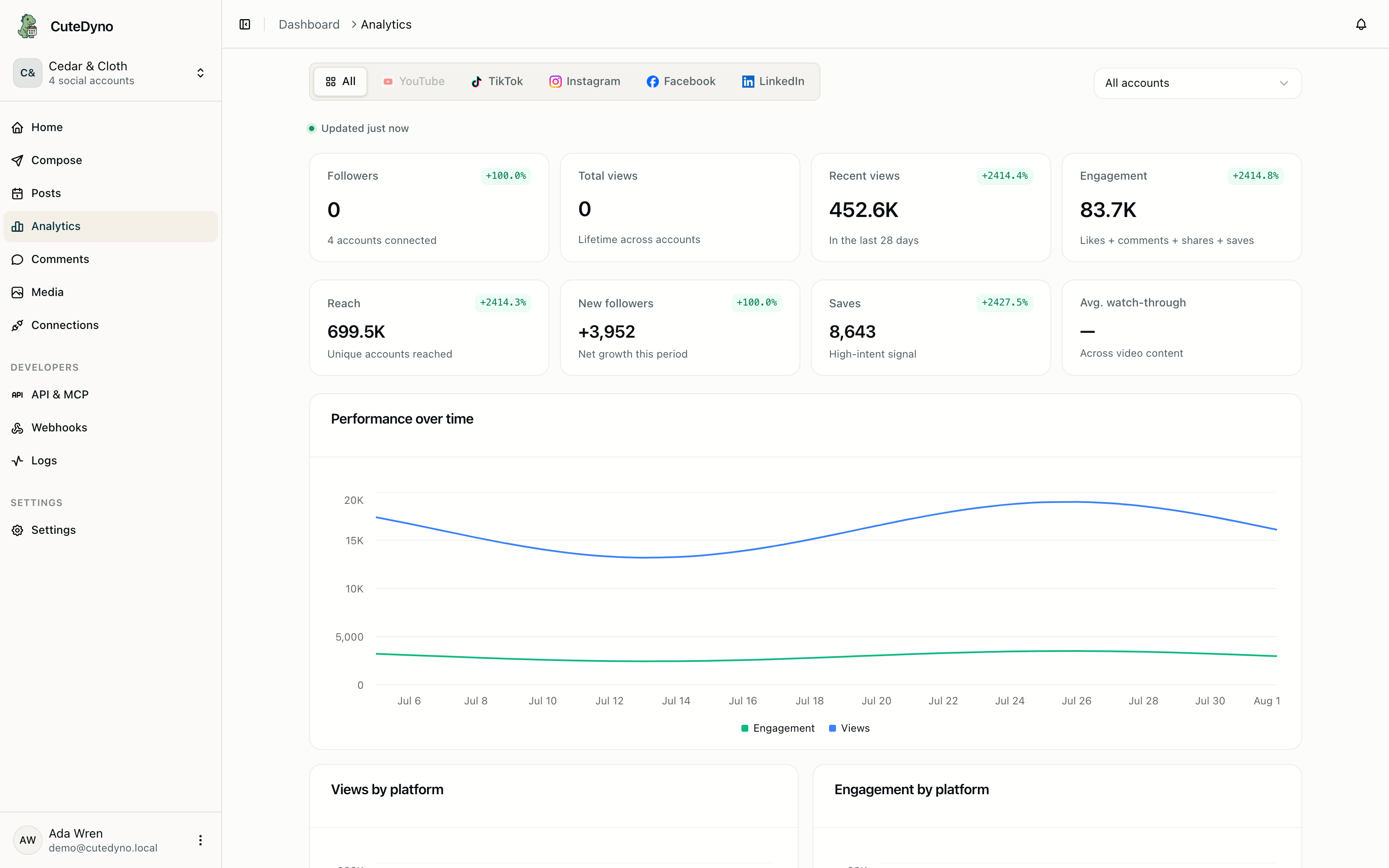
Published posts are tracked per platform, but the depth varies with what each API exposes:
| Platform | Available |
|---|---|
| Views, reach, saves, shares, likes, comments; average watch time on Reels | |
| Views, likes, comments, shares, reach; follower demographics by country and city | |
| TikTok | Views, likes, comments, shares per video; follower and video counts |
| YouTube | Views, likes, comments, shares, watch time, subscribers gained |
| Publishing history only, unless your app has Community Management access |
Comments
Comment sync and moderation work on Facebook and Instagram. TikTok, LinkedIn, and YouTube do not expose the webhooks or moderation endpoints needed, so GET /v1/comments returns Facebook and Instagram comments only.
In the dashboard, those same threads appear under Inbox.